Phaeodactylum tricornutum Bohlin
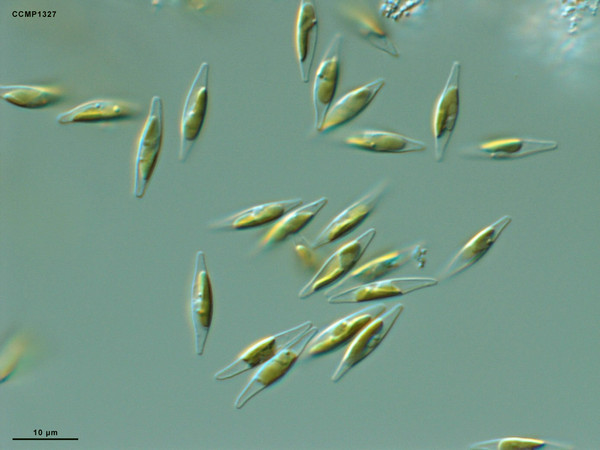
| Common Name | pennate diatom | ||||
| Taxonomy by Gene Sequence | No | ||||
| Collection Site | 40.6667°N -73.25°W Great South Bay, Long Island, New York, USA (lat long approximate) | ||||
| Ocean | North Atlantic | ||||
| Sea | Great South Bay, Long Island | ||||
| Nearest Continent | North America | ||||
| Collected By | Ryther,J | ||||
| Collection Date | |||||
| Isolated By | Ryther,J | ||||
| Isolated Date | |||||
| Identified By | |||||
| Deposited By | |||||
| Deposit Date | |||||
| Strain Synonyms | PHAEO | ||||
| Is The Strain Currently Axenic? | Yes | ||||
| When Was It Last Tested? | 05/23/2017 | ||||
| Other Information | Coll.in an encl.embayment w/ low salinity. Area heavily polluted by nearby duck farm. During Nannochloropsis/Nannochloris bloom. | ||||
| Authentic Type/Strain | No | ||||
| Morphological Data | |||||
| Attributes | Algae, Marine, Robust, High Lipid, Temperate | ||||
| Additional Resources | Genbank Genome Transcriptome AlgaeBase | ||||
| Genome Sequence Link | No | ||||
| Medium Used for Maintenance | L1 |
| Other Reported Growth Media | f/2, f/2 agar |
| Maintenance Temperature (°C) | 14 °C |
| Known Temperature Range (°C) | 11 - 25 °C |
| Cell Length (Min) | 12 |
| Cell Length (Max) | 14 |
| Cell Width (Min) | 2 |
| Cell Width (Max) | 4 |
The time required to regrow this culture, prior shipping, is approximately 14 days. If interested, please contact the CCMP for the cryopreservation methods (freezing and/or thawing protocols).
Note that aquaculture strains are always maintained as actively growing cultures, even if also cryogenically stored. Therefore, aquaculture strains (see aquaculture express ordering on the CCMP home page) can be shipped immediately upon request.
Documentation:
Flow scintillation counting of 14C-labeled microalgal photosynthetic pigments (https://academic.oup.com/plankt/article/18/10/1867/1463041)
Effect of acidification on preservation of DMSP in seawater and phytoplankton cultures: Evidence for rapid loss and cleavage of DMSP in samples containing Phaeocystis sp (https://www.sciencedirect.com/science/article/pii/S0304420310001386)
Antioxidant properties and lipid composition of selected microalgae (https://link.springer.com/article/10.1007/s10811-018-1523-1)
Supplementation of a diatom diet with cholesterol can enhance copepod egg-production rates (https://aslopubs.onlinelibrary.wiley.com/doi/abs/10.4319/lo.2004.49.2.0488)
Relationship between light absorption and the xanthophyll-cycle pigments in marine diatoms (https://www.researchgate.net/publication/229036956_Relationship_between_light_absorption_and_the_xanthophyll-cycle_pigments_in_marine_diatoms)