Synechococcus sp.
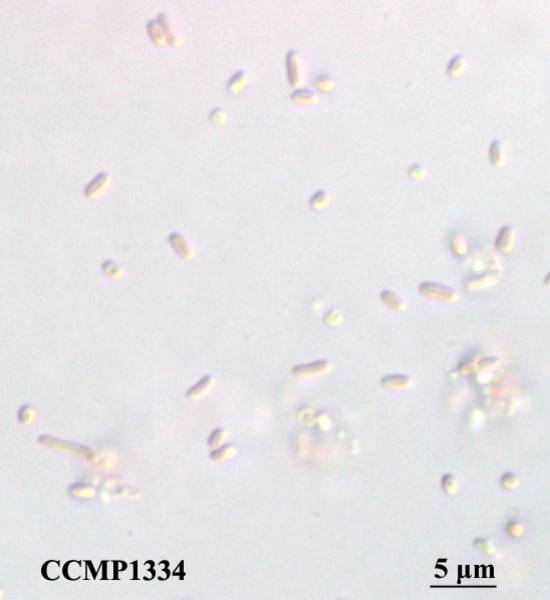
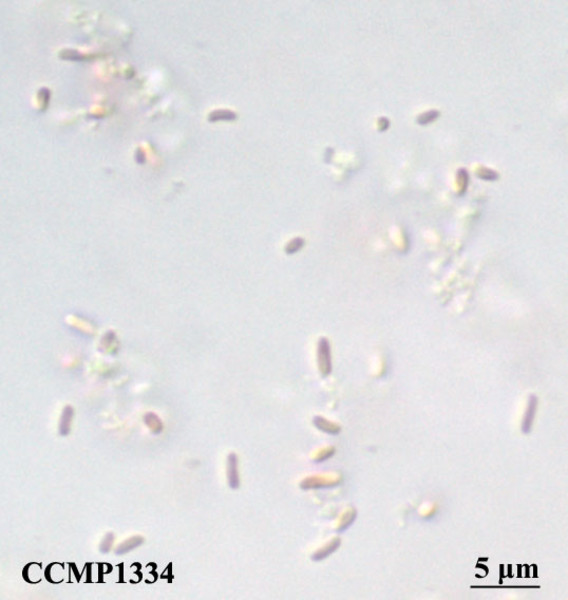

| Common Name | blue-green algae | ||||
| Taxonomy by Gene Sequence | No | ||||
| Collection Site | 33.7423°N -67.4913°W collection site unknown | ||||
| Ocean | North Atlantic | ||||
| Sea | Sargasso Sea | ||||
| Nearest Continent | Open ocean | ||||
| Collected By | Brand,L | ||||
| Collection Date | |||||
| Isolated By | Waterbury,J | ||||
| Isolated Date | 01/01/1980 | ||||
| Identified By | |||||
| Deposited By | Guillard,R | ||||
| Deposit Date | |||||
| Strain Synonyms | DC2, WH7803, NEPCC549, RCC 752 | ||||
| Is The Strain Currently Axenic? | Yes | ||||
| When Was It Last Tested? | 01/05/2026 | ||||
| Other Information | at 25 meters depth; red strain; grown in dim light | ||||
| Authentic Type/Strain | No | ||||
| Morphological Data | red | ||||
| Attributes | Algae, Marine, Warm Water | ||||
| Additional Resources | Genbank Genome Transcriptome AlgaeBase | ||||
| Genome Sequence Link | No | ||||
| Medium Used for Maintenance | L1 - Si |
| Other Reported Growth Media | f/2 agar, f/2-Si, f/2p, K, L1+NH4, SNTR |
| Maintenance Temperature (°C) | 24 °C |
| Known Temperature Range (°C) | 22 - 26 °C |
| Cell Length (Min) | 1 |
| Cell Length (Max) | 3 |
| Cell Width (Min) | 1 |
| Cell Width (Max) | 1 |
The time required to regrow this culture, prior shipping, is approximately 25 days. If interested, please contact the CCMP for the cryopreservation methods (freezing and/or thawing protocols).
Note that aquaculture strains are always maintained as actively growing cultures, even if also cryogenically stored. Therefore, aquaculture strains (see aquaculture express ordering on the CCMP home page) can be shipped immediately upon request.
New daughter set created every three weeks
Daughter set……….…13umol quanta m-2 s-1
Mother set………….…13umol quanta m-2 s-1
Grandmother set….…13umol quanta m-2 s-1
Documentation:
Diel patterns of growth and division in marine picoplankton in culture (https://onlinelibrary.wiley.com/doi/abs/10.1046/j.1529-8817.2001.037003357.x)
Ecotypic variation in phosphorus-acquisition mechanisms within marine picocyanobacteria (https://www.int-res.com/abstracts/ame/v39/n3/p257-269/)
Trait-dependent variability of the response of marine phytoplankton to oil and dispersant exposure (https://www.sciencedirect.com/science/article/pii/S0025326X20300242)
Physiological response of 10 phytoplankton species exposed to macondo oil and the dispersant, Corexit (https://pubmed.ncbi.nlm.nih.gov/29464721/)
The decomposition of hydrogen peroxide by marine phytoplankton (https://www.sciencedirect.com/science/article/pii/S0399178402000063)
Lysogeny in marine Synechococcus (https://www.nature.com/articles/415496a)
A trace metal clean reagent to remove surface-bound iron from marine phytoplankton (https://www.sciencedirect.com/science/article/pii/S0304420303000549)
Peptide hydrolysis and the uptake of dipeptides by phytoplankton (https://aslopubs.onlinelibrary.wiley.com/doi/abs/10.4319/lo.2009.54.3.0856)
Phosphate and ATP uptake and growth kinetics in axenic cultures of the cyanobacterium Synechococcus CCMP1334 (https://www.tandfonline.com/doi/full/10.1080/09670260500505037)
Abundance of amino sugars and peptidoglycan in marine particulate and dissolved organic matter (https://aslopubs.onlinelibrary.wiley.com/doi/abs/10.4319/lo.2003.48.1.0118)
Characterization of different viruses infecting the marine harmful algal bloom species Phaeocystis globosa (https://www.sciencedirect.com/science/article/pii/S0042682205004095?via%3Dihub)
Major bacterial contribution to the ocean reservoir of detrital organic carbon and nitrogen (https://aslopubs.onlinelibrary.wiley.com/doi/abs/10.4319/lo.2008.53.1.0099)
Ecological advantages from light adaptation and heterotrophic-like behavior in Synechococcus harvested from the Gulf of Trieste (Northern Adriatic Sea) (https://academic.oup.com/femsec/article/64/2/219/644110)