Thalassiosira weissflogii (Grun.) Fryxell et Hasle
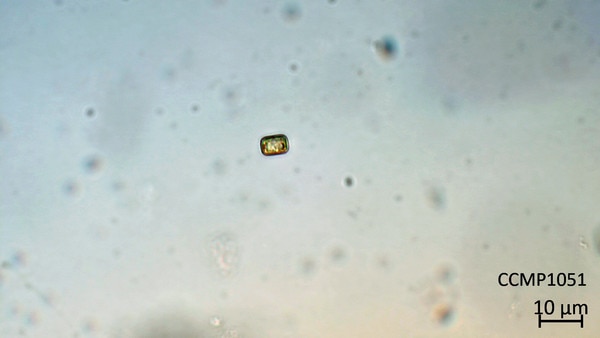
| Common Name | centric diatom | ||||
| Taxonomy by Gene Sequence | No | ||||
| Collection Site | 19.575°N -155.999°W King Kalakaua's Fishpond, Kahaluu, Hawaii USA | ||||
| Ocean | North Pacific | ||||
| Sea | |||||
| Nearest Continent | Open ocean | ||||
| Collected By | York,R | ||||
| Collection Date | |||||
| Isolated By | York,R | ||||
| Isolated Date | 05/13/1985 | ||||
| Identified By | Johansen,J | ||||
| Deposited By | Walsh,D | ||||
| Deposit Date | 08/15/1989 | ||||
| Strain Synonyms | THALA7, ARC32 | ||||
| Is The Strain Currently Axenic? | Yes | ||||
| When Was It Last Tested? | 06/03/2026 | ||||
| Other Information | euryhaline,warm water;common in brackish water Hawaii | ||||
| Authentic Type/Strain | No | ||||
| Morphological Data | |||||
| Attributes | Algae, Marine, Temperate, Aquaculture | ||||
| Additional Resources | Genbank Genome Transcriptome AlgaeBase | ||||
| Genome Sequence Link | No | ||||
| Medium Used for Maintenance | L1 |
| Other Reported Growth Media | f/2 |
| Maintenance Temperature (°C) | 14 °C |
| Known Temperature Range (°C) | 11 - 30 °C |
| Cell Length (Min) | 10 |
| Cell Length (Max) | 20 |
| Cell Width (Min) | 8 |
| Cell Width (Max) | 15 |
CCMP1051 was cryopreserved on Dec 28 2017 using 15% DMSO as a cryoprotectant.
The time required to regrow this culture, prior shipping, is approximately 14 days. If interested, please contact the CCMP for the cryopreservation methods (freezing and/or thawing protocols).
Note that aquaculture strains are always maintained as actively growing cultures, even if also cryogenically stored. Therefore, aquaculture strain starter cultures (2x15ml) and only starter cultures can be shipped within 24h of ordering (see aquaculture express ordering on the CCMP home page) .
New daughter set created every four weeks
Daughter set……….…25umol quanta m-2 s-1
Mother set………….….13umol quanta m-2 s-1
Grandmother set….….7umol quanta m-2 s-1
Q+A:
Q: We are going to buy 1 liter from the strain: CCMP1051 Thalassiosira weissflogii (Grun.) Fryxell et Hasle. What are the conditions to maintain axenic the strain and what nutrients and concentration?
A: CCMP 1051 is kept axenic by sterile technique under a Laminar Flow hood. Click herefor the L1 media recipe.
Q: If I put 2 vials in the freezer, would that keep for 2 months without cell quality interruptions?
A: Without following a cryopreservation protocol that includes a -80C freezer, liquid nitrogen vapor and a cryoprotective agent I wouldn't recommend freezing cultures. Ice formation disrupts lipid bilayers and will destroy the viability of the culture.
Q: We were wondering if you may have nutritional profile?
A: I am afraid that is not information that we have.
Documentation:
Cultivation of the Marine Pelagic Tunicate Dolioletta gegenbauri (Uljanin 1884) for Experimental Studies (https://pubmed.ncbi.nlm.nih.gov/31449255/)
Physiological adjustments and transcriptome reprogramming are involved in the acclimation to salinity gradients in diatoms (https://pubmed.ncbi.nlm.nih.gov/27236063/)
Nutrient temperature and light stress alter phosphorus and carbon forms in culture-grown algae (https://www.sciencedirect.com/science/article/pii/S0304420310000253)
Estimation of chromophoric dissolved organic matter (CDOM) and photosynthetic activity of estuarine phytoplankton using a multiple-fixed- wavelength spectral fluorometer (https://www.sciencedirect.com/science/article/pii/S0043135412009104)
Marine sources of ice nucleating particles: results from phytoplankton cultures and samples collected at sea (https://ui.adsabs.harvard.edu/abs/2016AGUFM.A51F0126W/abstract)
New tools for labeling silica in living diatoms (https://pubmed.ncbi.nlm.nih.gov/18069957/)