Rhodomonas sp.
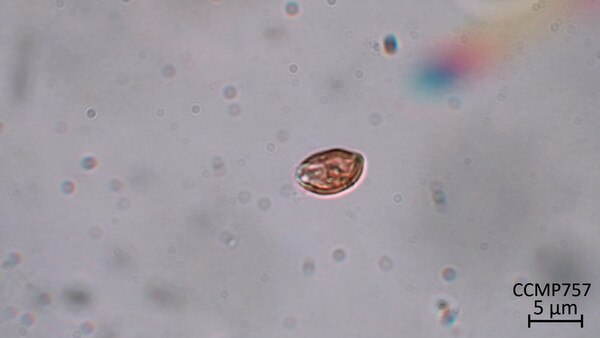
| Common Name | chromists | ||||
| Taxonomy by Gene Sequence | No | ||||
| Collection Site | 41.5264°N -70.67°W Eel Pond, Woods Hole, Massachusetts USA | ||||
| Ocean | North Atlantic | ||||
| Sea | Nantucket Sound | ||||
| Nearest Continent | North America | ||||
| Collected By | Stoecker,D | ||||
| Collection Date | 07/18/1982 | ||||
| Isolated By | Keller,M | ||||
| Isolated Date | |||||
| Identified By | Hill,DRA | ||||
| Deposited By | |||||
| Deposit Date | |||||
| Strain Synonyms | EPB14 | ||||
| Is The Strain Currently Axenic? | No | ||||
| When Was It Last Tested? | 02/15/2005 | ||||
| Other Information | |||||
| Authentic Type/Strain | No | ||||
| Morphological Data | flagellate | ||||
| Attributes | Algae, Marine, Temperate, Warm Water | ||||
| Additional Resources | Genbank Genome Transcriptome AlgaeBase | ||||
| Genome Sequence Link | No | ||||
| Medium Used for Maintenance | h/2 |
| Other Reported Growth Media | f/2-Si, K, L/20 |
| Maintenance Temperature (°C) | 24 °C |
| Known Temperature Range (°C) | 22 - 26 °C |
| Cell Length (Min) | 8 |
| Cell Length (Max) | 14 |
| Cell Width (Min) | 3 |
| Cell Width (Max) | 6 |
CCMP757 was cryopreserved on May 11 2007 using 15% DMSO as a cryoprotectant.
The time required to regrow this culture, prior shipping, is approximately 20 days. If interested, please contact the CCMP for the cryopreservation methods (freezing and/or thawing protocols).
Note that aquaculture strains are always maintained as actively growing cultures, even if also cryogenically stored. Therefore, aquaculture strains (see aquaculture express ordering on the CCMP home page) can be shipped immediately upon request.
The time required to regrow this culture, prior shipping, is approximately 20 days. If interested, please contact the CCMP for the cryopreservation methods (freezing and/or thawing protocols).
Note that aquaculture strains are always maintained as actively growing cultures, even if also cryogenically stored. Therefore, aquaculture strains (see aquaculture express ordering on the CCMP home page) can be shipped immediately upon request.
Documentation:
Recognizing toxic species in aquatic habitats: a potential concern in lake management (https://jlimnol.it/index.php/jlimnol/article/view/jlimnol.2003.172)
A bacterium that inhibits the growth of Pfiesteria piscicida and other dinoflagellates (https://www.sciencedirect.com/science/article/abs/pii/S1568988304000253)
A new larval fish bioassay for testing the pathogenicity of Pfiesteria spp. (Dinophyceae) (https://onlinelibrary.wiley.com/doi/abs/10.1046/j.1529-8817.2003.02106.x)
Contaminant-free cultivation of Pfiesteria shumwayae (Dinophyceae) on a fish cell line (https://www.int-res.com/abstracts/ame/v39/n1/p97-105/)