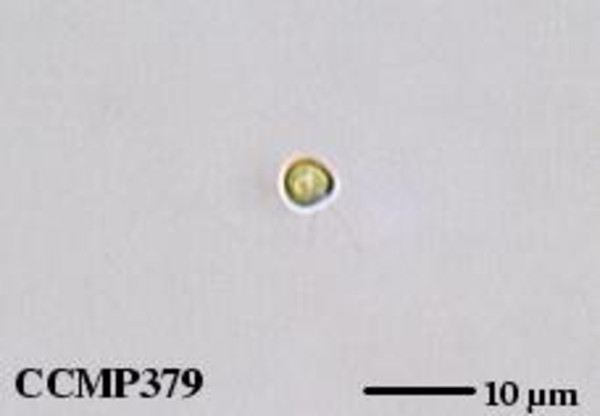
Emiliania huxleyi  (Lohm.) Hay et Mohler

(0)No Reviews yet
$25.00 to $1,150.00
SKU: CCMP379
Class: Prymnesiophyceae

Grown to Order

Common Namecoccolithophore
Taxonomy by Gene SequenceNo
Collection Site50.1669°N -4.2504°W
1mi west of the Eddystone, English Channel (lat long approximate)
OceanNorth Atlantic
Sea
Nearest ContinentEurope
Collected ByParke,M
Collection Date
Isolated ByParke,M
Isolated Date
Identified ByParke,M
Deposited ByBlankley,W
Deposit Date
Strain Synonyms92A, CCAP 920/1A; Plymouth 92, Plymouth 92d aka MBAUK 92d, UTEX1016
Is The Strain Currently Axenic?Yes
When Was It Last Tested?06/15/2025
Other Informationno coccoliths
Authentic Type/StrainNo
Morphological Datano coccoliths
AttributesAlgae, Marine, Temperate
Additional ResourcesGenbank
Genome
Transcriptome
AlgaeBase
Genome Sequence LinkNo
Medium Used for MaintenanceL1 - Si
Other Reported Growth Mediaf/2-Si
Maintenance Temperature (°C)14 °C
Known Temperature Range (°C)11 - 16 °C
Cell Length (Min)3
Cell Length (Max)5
Cell Width (Min)3
Cell Width (Max)5
CCMP379 was cryopreserved on Apr 1 2016 using 9% DMSO as a cryoprotectant.

The time required to regrow this culture, prior shipping, is approximately 34 days. If interested, please contact the CCMP for the cryopreservation methods (freezing and/or thawing protocols).

Note that aquaculture strains are always maintained as actively growing cultures, even if also cryogenically stored. Therefore, aquaculture strains (see aquaculture express ordering on the CCMP home page) can be shipped immediately upon request.

New daughter set created every four weeks at 10uL into 18mL

Daughter set……….…16umol quanta m-2 s-1

Mother set………….….10umol quanta m-2 s-1

Grandmother set….….4umol quanta m-2 s-1

Q+A:

Q: Please may you confirm whether CCMP379 is still axenic? How do you test for axenity? Likewise for CCMP3266

A: CCMP379 is tested regularly in test media as well as visual inspection with a compound microscope.

Documentation:

Partial characterization of dimethylsulfonio-propionate (DMSP) lyase isozymes in 6 strains of Emiliania huxleyi (https://www.jstor.org/stable/24831855)

The bacterial symbiont Phaeobacter inhibens shapes the life history of its algal host Emiliania huxleyi (https://www.frontiersin.org/articles/10.3389/fmars.2018.00188/full)

A genetic marker to separate Emiliania huxleyi (prymnesiophyceae) morphotypes (https://onlinelibrary.wiley.com/doi/abs/10.1111/j.1529-8817.2005.04188.x)

The effect of light stress on the release of volatile iodocarbons by three species of marine macroalgae (https://aslopubs.onlinelibrary.wiley.com/doi/10.4319/lo.2006.51.6.2849)

Chemical defense in the microplankton I: feeding and growth rates of heterotrophic protists on the DMS-producing phytoplankter Emiliania huxleyi (https://aslopubs.onlinelibrary.wiley.com/doi/10.4319/lo.2003.48.1.0217)

Ratings & Reviews

No reviews available

Be the first to Write a Review