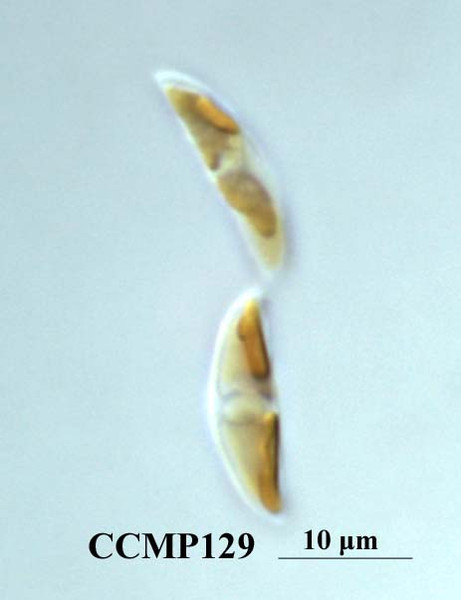
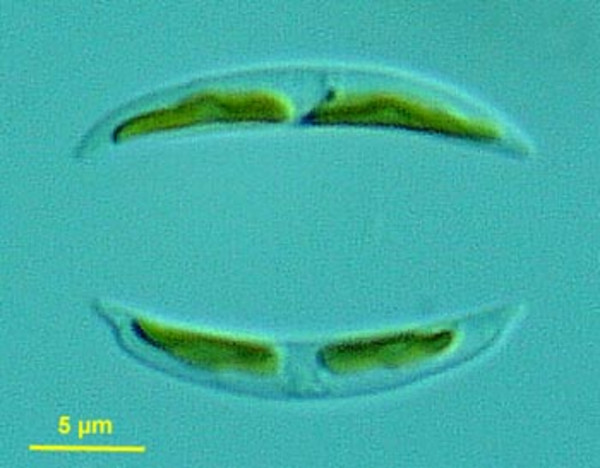
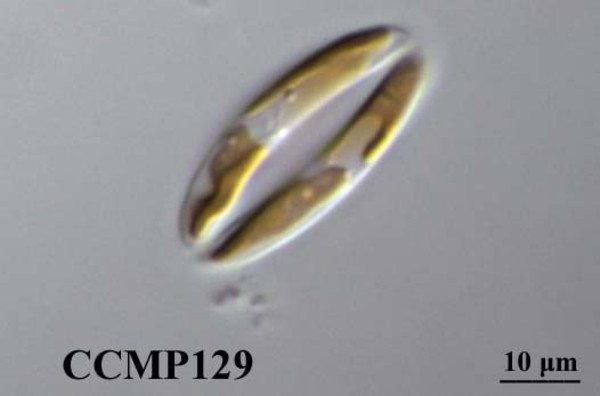
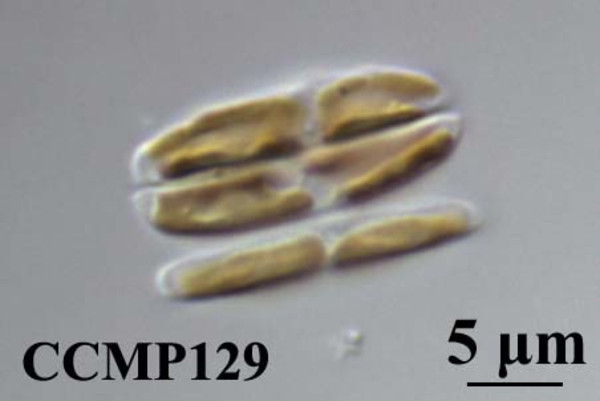
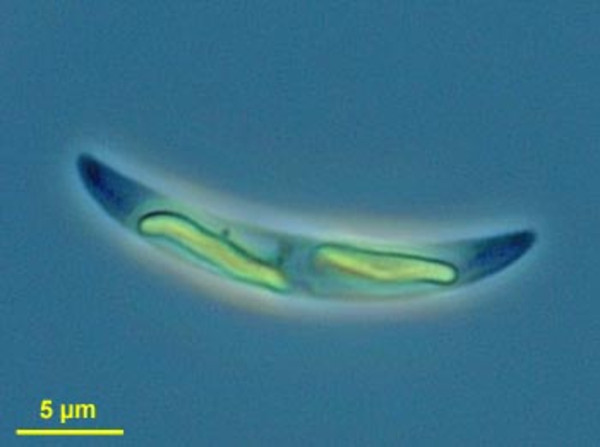
Amphora sp.
| Common Name | pennate diatom | ||||
| Taxonomy by Gene Sequence | No | ||||
| Collection Site | 22°N -72°W Little Water Cay, Turks and Caicos Islands, British West Indies | ||||
| Ocean | North Atlantic | ||||
| Sea | Caribbean Sea | ||||
| Nearest Continent | North America | ||||
| Collected By | Glazer,R | ||||
| Collection Date | |||||
| Isolated By | Selvin,R | ||||
| Isolated Date | 06/01/1985 | ||||
| Identified By | |||||
| Deposited By | Davis | ||||
| Deposit Date | 11/19/1984 | ||||
| Strain Synonyms | NTZ | ||||
| Is The Strain Currently Axenic? | Yes | ||||
| When Was It Last Tested? | 01/28/2002 | ||||
| Other Information | 3-4' bank waters on algal mat on sandy substrate, 28C, 36ppt; | ||||
| Authentic Type/Strain | No | ||||
| Morphological Data | |||||
| Attributes | Algae, Marine | ||||
| Additional Resources | Genbank Genome Transcriptome AlgaeBase | ||||
| Genome Sequence Link | No | ||||
| Medium Used for Maintenance | L1 |
| Other Reported Growth Media | f/2 |
| Maintenance Temperature (°C) | 20 °C |
| Known Temperature Range (°C) | 18 - 26 °C |
| Cell Length (Min) | 9 |
| Cell Length (Max) | 16 |
| Cell Width (Min) | 4 |
| Cell Width (Max) | 6 |
CCMP129 was cryopreserved on Nov 3 2000 using 12% DMSO as a cryoprotectant.
The time required to regrow this culture, prior shipping, is approximately 32 days. If interested, please contact the CCMP for the cryopreservation methods (freezing and/or thawing protocols).
Note that aquaculture strains are always maintained as actively growing cultures, even if also cryogenically stored. Therefore, aquaculture strains (see aquaculture express ordering on the CCMP home page) can be shipped immediately upon request.
The time required to regrow this culture, prior shipping, is approximately 32 days. If interested, please contact the CCMP for the cryopreservation methods (freezing and/or thawing protocols).
Note that aquaculture strains are always maintained as actively growing cultures, even if also cryogenically stored. Therefore, aquaculture strains (see aquaculture express ordering on the CCMP home page) can be shipped immediately upon request.
Documentation:
Does the red tide dinoflagellate Karenia brevis use allelopathy to outcompete other phytoplankton? (https://aslopubs.onlinelibrary.wiley.com/doi/abs/10.4319/lo.2005.50.3.0883)
Effects of harmful algal blooms on competitors: allelopathic mechanisms of the dinoflagellate Karenia brevis (https://aslopubs.onlinelibrary.wiley.com/doi/abs/10.4319/lo.2008.53.2.0531)
Competing phytoplankton undermines allelopathy of a bloom-forming dinoflagellate (https://pubmed.ncbi.nlm.nih.gov/18713720/)


